
I always like doing the out of the ordinary jobs on site. I like it even more when other trades have to ask you how you did it! |
| A relatively tight curve |
This was the case with some skirting I fitted to a curved wall today. It was quite a tight curve and it wasn't a quick job to fix it on, but with a bit of preparation I got the skirting to perfectly match the curve of the wall.
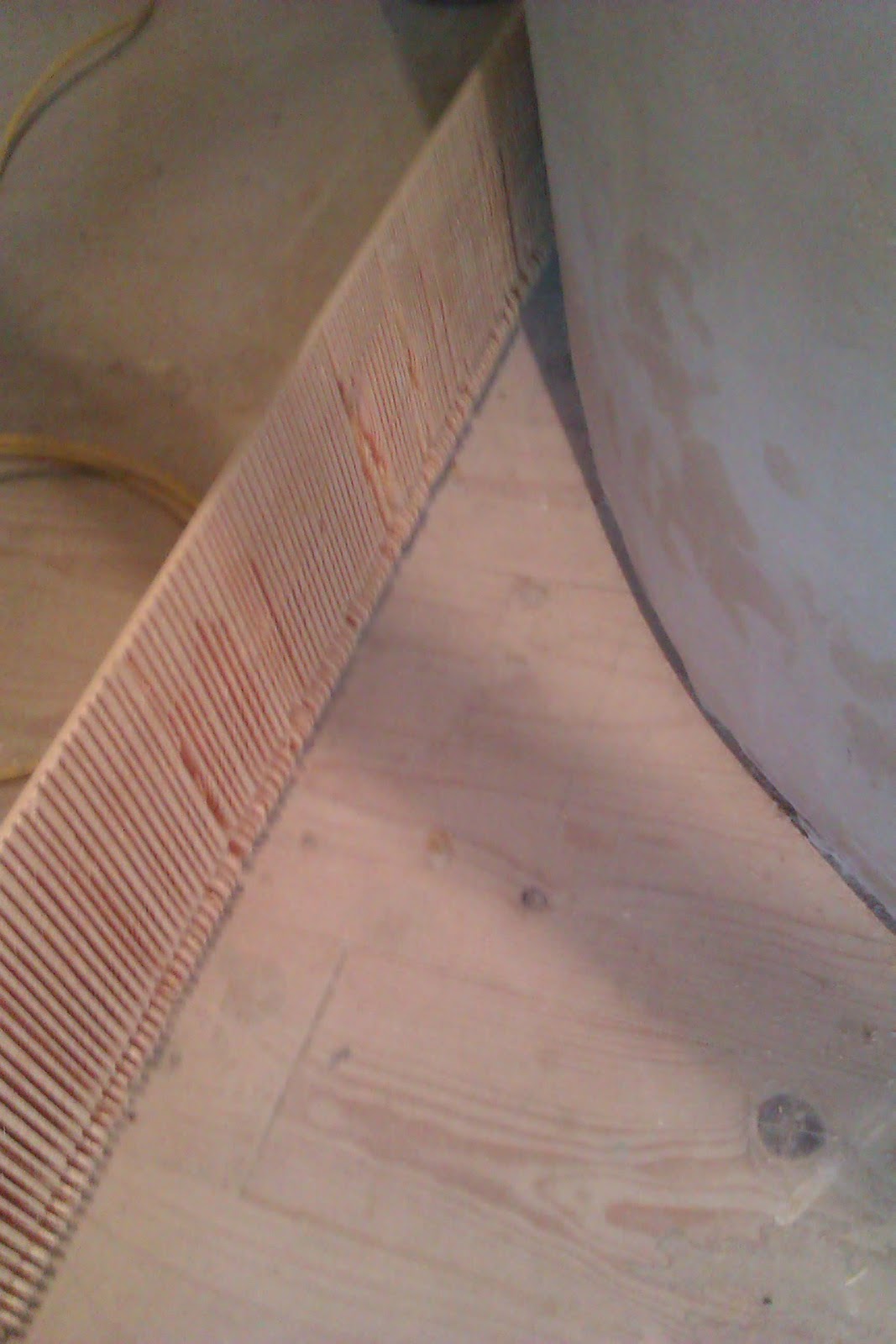 |
| Kerfing out the back of the skirting, as the curve was tight I needed lots |
How's it done? Well you can read any good book on carpentry and it will tell you about "kerfing" the back or front of a board to make it bend round a curve. But until you try and do it you yourself you'll never know if you can do it properly or how close the cuts will have to be. A kerf is the width of material removed by the saw blade, adding lots of these evenly lets the wood bend a certain amount.
 |
| A good, even curve |
This curve was quite tight and as the skirting had a moulding on it I could only trench the saw so deep on the first pass, I "kerfed" the back of the skirting for the length of the curve leaving a 2mm bit of wood in between each cut. I then trench cut deeper at the base of the skirting where it was thicker to remove even more wood. I then removed some wood from the back with the electric plane to try prevent it from cupping as all the tension had been taken out of one side with the cuts.
 |
| A job that when it's done right looks really good |
To fit it to the wall I first fixed the short straight run, then started to bend it round the curve. To make the wood bend easier I first poured some boiling water on the back and trickled it over the skirting as I bent it round until I could get a fixing on the far side. I then added plenty of fixings to prevent it moving when it drys out.
Another enjoyable, usual job.
Anyone else have to fix curved work lately?

